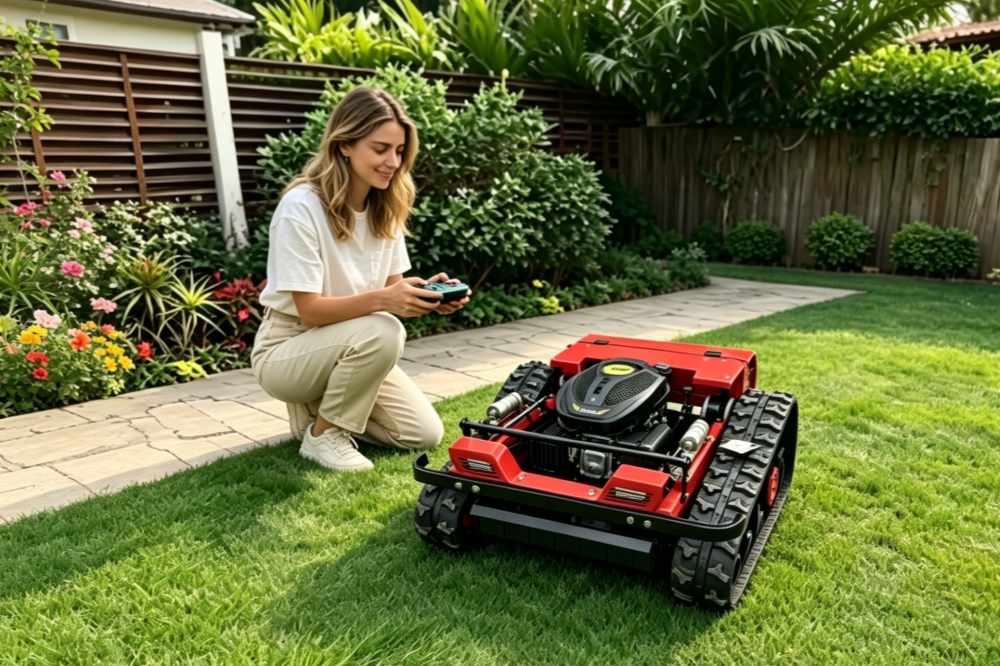

Remote Control Lawn Mowers
From Manual Labor to Smart Yard Management
With the advancement of garden maintenance technology, remote-controlled lawn mowers — as efficient and safe automated equipment — are gradually replacing traditional manual or ride-on mowers, and becoming the preferred tool for managing private courtyards, orchards, and lawns on complex terrain. The following is a comprehensive analysis of their core technology, working principle, advantages, and application scenarios.
1. What Is a Remote-Controlled Lawn Mower?
A remote-controlled lawn mower is a self-propelled mowing device that can be operated via a wireless remote control. It breaks the limitation of traditional mowers, which require the operator to walk behind or ride the machine, and achieves a "separation of operator and machine" mode. The operator only needs to stand at a safe distance and hold the remote control to command the machine to move forward, backward, steer, pivot in place, and adjust the cutting height.
2. Core System Composition
A remote-controlled lawn mower is mainly composed of four core systems that work together to ensure efficient and stable performance:
① Power & Drive System
Power source: Mainstream models use high-performance four-stroke gasoline engines (ranging from 7.5 to 22 HP), providing strong, sustained power output. Some high-end or eco-friendly models have begun to adopt solar-assisted charging or pure electric drive to reduce energy consumption and emissions.
Features: The engine usually has a self-charging function, ensuring continuous power supply during operation and supporting long runtime.
② Travel System
Crawler design: Most professional-grade remote-controlled lawn mowers use rubber track chassis. Steel wires embedded in the tracks enhance durability; the large ground contact area and low ground pressure prevent sinking into soft soil while protecting lawn roots from compaction.
All-terrain adaptability: Compared with wheeled structures, tracks offer excellent grip and stability on slopes (up to 30° or more), slippery grass, muddy roads, and rugged terrain, making them far less prone to slipping or tipping.
Mobility: Supports 360° pivot turns with a very small turning radius, allowing flexible maneuvering between obstacles such as trees and flower beds.
③ Mowing System
Cutter head & blade: Equipped with a wide cutter head (commonly 55–80 cm), greatly reducing the number of passes and improving efficiency. Blades are mostly made of high-hardness alloy steel (e.g., 65Mn), which is wear- and impact-resistant, and can cut through coarse, tough weeds and even small shrub branches.
Height adjustment: Supports remote, one-click adjustment of cutting height (typically 4–12 cm). Users can flexibly set the stubble height according to their lawn's needs to promote healthy growth.
④ Electronic Control & Communication System
Wireless remote control: Using a professional remote control similar to that of an agricultural crop-spraying drone, the effective range reaches 45 m to over 100 m, with stable signals and low latency.
Intelligent sensing: Built-in slope sensors and obstacle-detection sensors (ultrasonic/infrared). When a steep slope or obstacle is detected ahead, the electronic control system can automatically adjust its posture or prompt avoidance to ensure safe operation.
Human–machine interaction: The remote control screen displays real-time battery level, signal strength, and working status, and issues audio and visual alarms when the battery is low.
3. Overview of Working Principle
Command sending: The operator sends control commands (e.g., forward, turn left, start blade) via the remote control joystick or buttons.
Signal transmission: The remote control encodes the commands into wireless signals and transmits them.
Reception & decoding: The wireless communication module on the mower receives the signals and passes them to the central microprocessor (electronic control system).
Execute action: The microprocessor parses the instructions, sends power-distribution signals to the travel motors, and controls the speed difference between the left and right tracks to achieve steering or straight travel. Simultaneously, it drives the cutting mechanism to spin the blade at high speed.
Sensor feedback: Sensors provide real-time environmental data; if any abnormality is detected (such as excessive tilt), the system automatically intervenes for protection.
4. Main Advantages
Easy to operate: Requires no physical exertion — easily operated by the elderly, women, or those with less strength. Sit in the shade and control everything, turning tedious labor into a relaxed experience.
High safety: The operator keeps a safe distance from the high-speed blade, avoiding accidental injury. With emergency braking and obstacle avoidance, it is especially suitable for families with children or pets.
Strong terrain adaptability: Perfectly solves the pain points traditional mowers struggle with — slopes, wetlands, and gravel roads. The track design enables stable lateral operation on 30° slopes.
Efficient: A wide cutting width (e.g., 80 cm) combined with straight-line driving stability makes operation more than twice as fast as manual push mowers, saving several hours of maintenance per month on average.
Soil-friendly: Low-pressure, heavy-duty tracks reduce damage to soil structure, benefiting lawn-root respiration and water retention, in line with ecological horticulture.
5. Application Scenarios
Private courtyards: Suitable for residences with large lawns, slopes, or irregular terrain. Owners can easily care for the yard during weekend leisure, improving quality of life.
Landscaping: Large green spaces such as urban parks, golf courses, and squares. Fine pruning can be done around flower beds, lakesides, and rockeries to keep the landscape neat and beautiful.
Agricultural production: Orchards, tea gardens, vineyards, etc. It can shuttle and weed freely between fruit-tree rows without damaging crops. The cut clippings can also be used as natural green manure returned to the soil, reducing labor costs.
Ranches & livestock farms: Regularly trim grass to provide quality feed; remote operation avoids disturbing livestock and keeps the breeding environment orderly.
6. Daily Maintenance Suggestions
Although remote-controlled lawn mowers are highly intelligent, proper maintenance extends their service life:
Cleaning: After each use, clear grass debris wrapped around the bottom of the cutter head and rinse with a high-pressure washer (avoid electrical interfaces).
Inspection: Regularly check the oil level, air-filter cleanliness, and track wear.
Blade care: Monitor blade sharpness; sharpen or replace promptly once dulled. Most models support a quick-release design for easy replacement.
Battery care: For electric or hybrid models, manage lithium-battery charge/discharge, and store at a partially charged state during long idle periods.
Conclusion
Remote control lawn mowers are not only a tool upgrade, but a transformation of yard lifestyle. They turn heavy physical labor into easy, intelligent control, making lawn care efficient, safe, and enjoyable. For users who pursue a high-quality lifestyle, have complex terrain, or simply want to free their hands from chores, a remote lawn mower is a worthwhile investment.