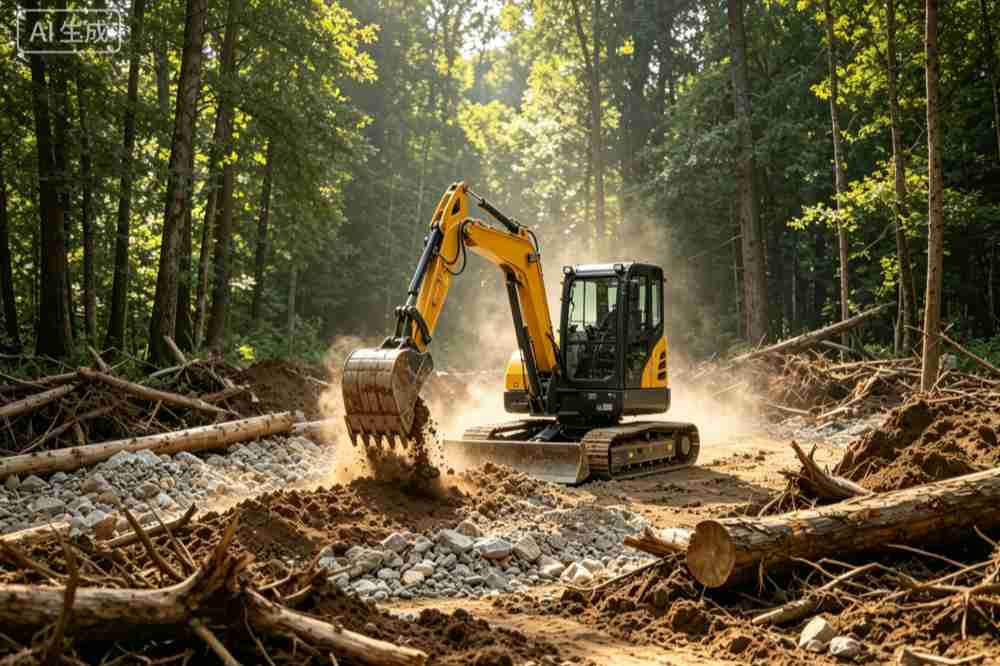

Small Excavator: Technical Principles & Applications
Parameters · Multifunction · Safety · Maintenance
Small excavators, especially agricultural models, are among the most widely used machines in earthmoving equipment. Their compact body, flexible operability, and multifunctionality make them an efficient solution for orchard drainage, foundation renovation, and indoor construction. These machines typically feature hydraulic transmission and customizable attachments, adapting to diverse working conditions and becoming indispensable in modern engineering operations.
Technical Principles & Core Parameters
Small excavators use a hydraulic transmission system that converts mechanical energy into hydraulic energy via the hydraulic pump, driving the bucket, boom, and stick to execute digging cycles. Key parameters define the machine's capability:
• Operating weight: ~2.88 tons — a balance of stability and maneuverability
• Bucket capacity: 0.08 m³ — optimized for fine, precise operations
• Maximum digging depth: 2,700 mm — sufficient for shallow trenching and foundation work
• Max grading ability (angle): 40° — capable of handling moderate slopes
• Travel speed: 4.0 km/h — adequate for short-distance site movement
The backhoe bucket design also minimizes soil spillage onto the operator's line of sight during reverse digging, improving both efficiency and safety.
Function Expansion & Application Scenarios
The true versatility of small excavators comes from their quick-coupler attachment system. Beyond the standard bucket, users can install a variety of tools:
Soil loosener: Breaks compacted ground before excavation.
Rotary rake: Screens soil, removes debris, and grades surfaces.
Bulldozer blade: Provides push-force for backfilling and leveling.
Breaker hammer: Breaks concrete, rock, and hardened surfaces.
Grab bucket: Handles logs, rocks, and irregular materials.
For example, in orchard drainage projects, the hydraulic lift function adjusts trench depth precisely, while a dozer blade quickly cleans and shapes the trench. In offline toilet renovation, the compact body fits through narrow passages, and the rotary rake demolishes old structures efficiently. This "one machine, many tools" capability significantly reduces equipment procurement costs across different job types.
Operational Advantages
Compared to large excavators, small equipment has a lower operating threshold. The tracked chassis provides excellent ground adhesion, and combined with swing-and-strafe (angled travel) capability, the machine remains stable on mud, slopes, and uneven terrain.
Precise hydraulic control enables micro-scale operations — for instance, cutting wall slots for electrical conduits with millimeter-level accuracy during interior renovation. Some models also support custom configuration: operators can adjust bucket width, boom length, and stick length to match specific job requirements, further optimizing performance.
Safety & Maintenance
Always follow safety regulations when operating excavators:
• Inspect hydraulic system seals before starting — leaking oil leads to power loss and component damage.
• On slopes, keep the machine perpendicular to the gradient to prevent tipping.
• When swapping attachments, shut off the engine and hang a "Do Not Operate" warning sign to prevent accidental startup.
Maintenance schedule: Replace hydraulic oil every 200 operating hours; check track tension every 500 hours. Regular lubrication of all grease points and timely inspection of wear parts will extend service life and maintain peak performance.