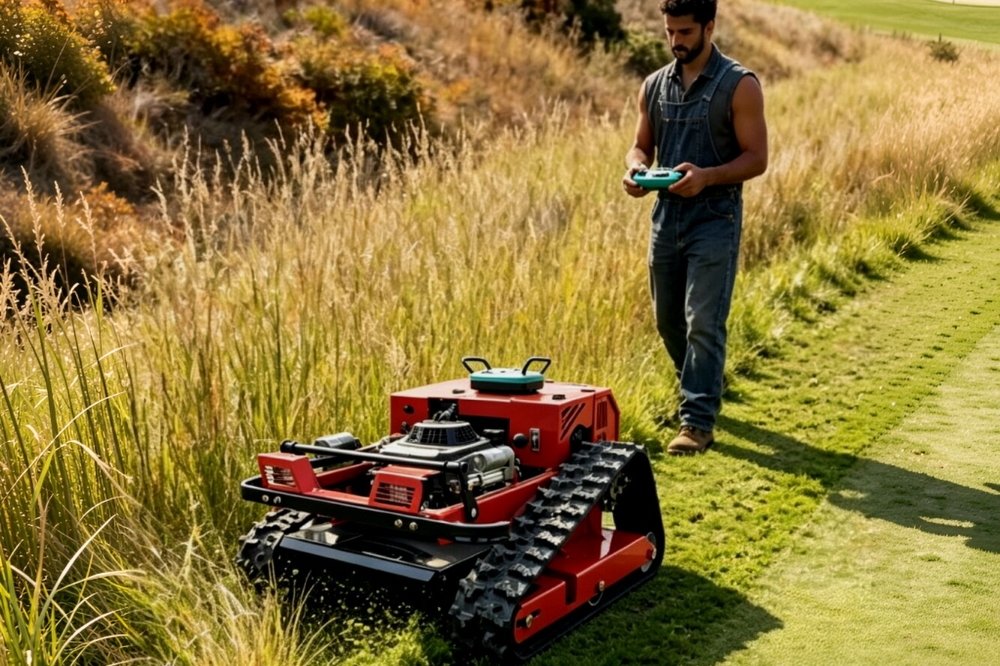

Tracked Lawn Mower
Terrain Adaptability · Efficiency · Long-term Cost Optimization
In garden maintenance, farmland management, or large-scale site upkeep, mowing efficiency and terrain adaptability are always the core challenges. Traditional wheeled lawn mowers tend to slip on muddy, sloping, or gravel surfaces, while tracked lawn mowers have become the preferred tool for complex terrain operations thanks to their unique walking system. This article systematically analyzes the value of this equipment from three angles: mechanical structure, performance advantages, and applicable scenarios.
Track Design: Engineering Logic
The core of a tracked system is pressure dispersion — increasing the contact area to distribute weight. Think of a tank: its tracks spread tens of tons across several square meters, preventing it from sinking into soft soil. Similarly, the rubber or metal tracks of a tracked lawn mower connect to drive wheels via a chain assembly, forming a continuous support surface.
This design maintains stable traction on wet grasslands, sandy areas, or slopes exceeding 15°, where traditional wheeled equipment would slip, sink, or stall.
Material choice matters: Rubber tracks offer quiet, shock-absorbing operation — ideal for parks and golf courses. Metal tracks excel in wear resistance, better suited for farmland and construction sites. Some models feature detachable tracks, letting users swap them quickly to match different operational needs.
Three Core Advantages
1. Revolutionary terrain adaptability
Experimental data shows that on muddy grassland with 25% moisture content, tracked lawn mowers achieve more than three times the passability of wheeled equipment. Their low ground pressure design also avoids damaging surface vegetation — making them ideal for ecological restoration projects and ancient tree protection zones.
2. Significantly improved work safety
The anti-slip characteristics of the track system greatly reduce rollover risk. On slopes, gravity distribution is more uniform, and with automatic speed-limiting devices, rollover probability stays below 0.3%. Some models also feature emergency braking systems that cut power output when track slip is detected.
3. Long-term cost optimization
Although the initial purchase cost of tracked models is 15–20% higher than wheeled ones, their maintenance cycle extends to over 2,000 hours (vs. 800–1,200 for wheeled). Track replacement frequency is also significantly lower than tire replacement, reducing overall lifecycle cost by approximately 25%. For professional users averaging over 500 working hours annually, the economic advantage is especially clear.
Scenario Application Guide
Municipal landscaping: Lightweight rubber track models (under 300 kg total weight) are most popular. Their low noise (≤75 dB) meets nighttime operation requirements in residential areas, and adjustable mowing height (20–150 mm) adapts to seasonal lawn needs.
Agricultural use: Prioritize power configuration. Diesel engine models (≥15 kW) are recommended for stable torque output and ability to handle tall crop residue.
Extreme terrain (swamps, rocky areas): Pay attention to track tread design. Deep-tread tracks enhance grip but accelerate ground wear; shallow-tread tracks prioritize passability and surface protection. Test drives or supplier consultations can help find the right match.
The cross-industry application of track technology — from military equipment to civilian machinery — confirms the universal value of sound engineering design. The普及 of tracked lawn mowers not only solves complex terrain operations but also drives garden machinery toward greater specialization. Whether you are a professional maintenance team or an individual user, choose by weighing your operating scenario, budget, and long-term maintenance costs. It is recommended to obtain product parameters through official channels.