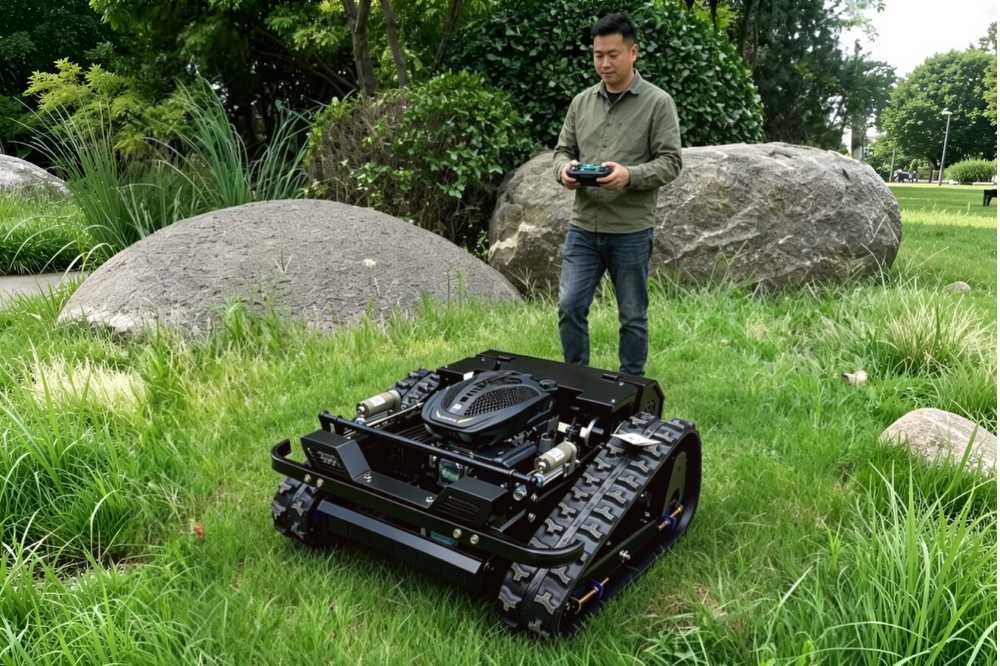

Automatic Remote-Controlled Lawn Mower
A Practical Guide for Modern Garden Maintenance
Are you still troubled by pushing a bulky lawn mower under the scorching sun? The emergence of automatic remote-controlled lawn mowers is transforming traditional garden maintenance. These machines eliminate the need for manual operation — you control the entire mowing process via a remote or mobile app, making lawn care easier and more efficient. This article systematically introduces this practical gardening tool, covering its working principles, core advantages, application scenarios, and key selection criteria.
How It Works
The core working principle of an automatic remote-controlled lawn mower is straightforward. It consists of four main components:
Power system: Usually an electric motor or gasoline engine that provides energy for blade rotation and movement.
Blade assembly: Responsible for cutting grass — typically using rotating blades or reciprocating blades.
Walking mechanism: Wheels and drive motors that support forward, backward, and turning movements.
Remote control module: Receives wireless signals to achieve remote operation. Some models are also equipped with sensors that automatically detect boundaries and obstacles, improving operational safety.
Core Advantages
Compared to traditional manual lawn mowers, automatic remote-controlled models offer several clear benefits:
Significantly reduces labor: The operator simply stands aside and controls remotely — no bending or pushing required. This is especially valuable for large courtyards or sloping terrain.
Higher mowing efficiency: Adjustable walking speed and wider blade coverage mean large areas can be completed in a single pass.
Greater operational flexibility: The remote control allows the machine to reach narrow corners and flower bed edges that are difficult to access manually, achieving more precise trimming.
Enhanced safety features: Some models include automatic recharge and emergency stop functions for safer operation.
Application Scenarios
Automatic remote-controlled lawn mowers are mainly suitable for home courtyards, small parks, stadium lawns, and farm lawns. Key matching considerations:
Power and cutting width should match your lawn area — too low power slows progress, while excessive power wastes resources. Battery life is also important; a single charge typically supports 1–2 hours of work, sufficient for small to medium-sized lawns.
How to Choose
When selecting an automatic remote-controlled lawn mower, pay attention to these key points:
Remote control distance & signal stability: Choose products with an effective range of at least 50 meters in open environments to ensure reliable operation across your entire yard.
Blade material & replacement convenience: Good blades are wear-resistant and stay sharp; replacement should be simple.
Weight & terrain adaptability: Heavier models may slip on wet grass; lighter models may lack stability. Balance these based on your terrain.
Safety & after-sales: Check for overload protection, low-battery warnings, and ease of maintenance support.
Daily Maintenance
Proper daily maintenance significantly extends the machine's service life:
After each use, clean the blade and grass debris from the chassis to prevent corrosion.
Regularly check whether blades are dull or loose — sharpen or replace promptly.
Charge and discharge the battery according to instructions to avoid damage from deep discharge.
Store in a dry, ventilated place away from direct sunlight to prevent shell aging.
Future Trends
Automatic remote-controlled lawn mowers are increasingly integrating with smart home ecosystems. Some new models now support scheduled tasks, automatic return to shelter before rain, work area delineation, and even weather data integration. While these features are not yet widespread, they show the direction toward truly unmanned, intelligent lawn maintenance. For ordinary users today, choosing a reliable and cost-effective remote-controlled lawn mower can already significantly improve your courtyard maintenance experience.
If you are considering upgrading your lawn care tools, take time to compare different models of automatic remote-controlled lawn mowers and make a decision based on your lawn area, terrain complexity, and budget. After all, the transition from manual to remote control is not just a tool upgrade — it is an optimization of your lifestyle.