
Ordinary Lawn Mower vs. Remote-Controlled Lawn Mower
Which One Really Saves You Money?
Many growers and yard owners hesitate about the cost-effectiveness of ordinary lawn mowers, thinking remote-controlled models are too expensive and unnecessary. But those who truly manage orchards, slopes, and large courtyards know that although both appear to be weed control tools, their actual usage experience, labor costs, and safety factors differ greatly. Choosing the wrong model can waste a lot of manpower and financial resources every year — resulting in long-term losses of tens of thousands of yuan. Today, we compare a regular handheld/manual lawn mower with a remote-controlled lawn mower in all aspects, so you can make an informed decision and save money.
Part 1: Ordinary Lawn Mower — The Hidden Costs
The most common ordinary lawn mowers on the market fall into two categories: gasoline-powered models and lithium-electric handheld models — also the initial choices of most farmers.
Physical toll: Regular lawn mower operation has a mandatory requirement — the operator must follow the machine throughout the entire process. Backpack-style models require carrying the weight on your body; prolonged operation causes shoulder pressure and arm numbness from vibration. Push-type models require bending over and manually controlling direction. When working under fruit trees or on slopes, you're hunched over the entire time. After half a day, the lower back becomes sore and unbearable — difficult for elderly farmers to endure.
Safety risks: From a safety perspective, the shortcomings of ordinary lawn mowers are very obvious. When cleaning steep slopes and riverbank edges, operators standing on sloping surfaces are prone to slipping and falling. Thorns, poisonous insects, and gravel hidden in the grass can easily scratch the skin at close working range. There is also the risk of blade rebound injuries when encountering hard objects such as stones. In orchards, operators shuttle between rows of fruit trees — a moment's carelessness can scratch bark or knock off young fruits, affecting that year's yield.
Efficiency limitations: A single person using a regular lawn mower needs at least half a day for fine weeding in one acre of orchard. For large areas, you can only repeatedly hire help. Nowadays, the daily wage for weeding workers increases year by year. Orchards need weeding 4–6 times per year, and long-term employment expenses easily exceed 10,000 yuan. Adding machine maintenance and fuel consumables, it becomes a significant annual expense.
Part 2: Remote-Controlled Lawn Mower — The Core Advantage
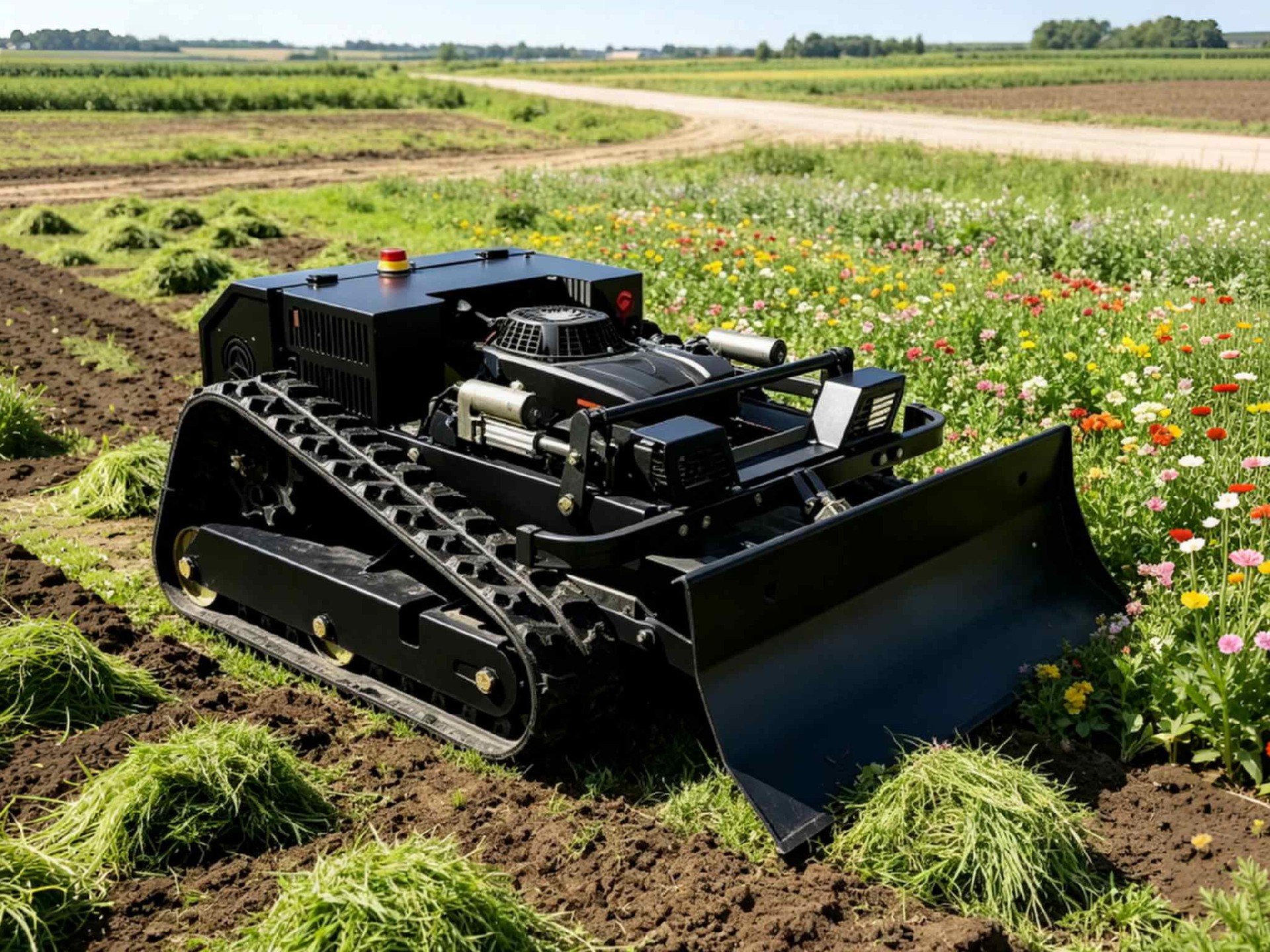
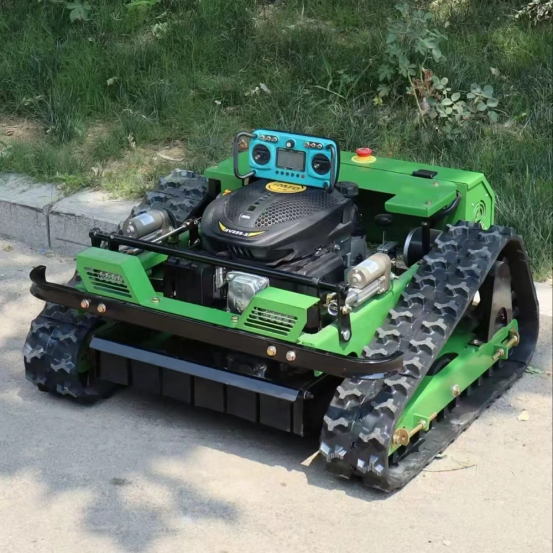
Let's look at the remote-controlled lawn mower specifically designed for orchards and slopes. Its core advantage is the separation of man and machine with long-distance control — this is also the key differentiator.
During operation, the person stands on flat, safe ground and controls the machine to move forward, turn, start, and stop via remote control. There's no need to crawl into the grass or bend over — completely eliminating shoulder and back pain. Even middle-aged and elderly farmers can operate it with ease. No close contact with weeds means no exposure to mosquitoes, snakes, insects, thorns, and scratches. Risky climbing on steep slopes is eliminated entirely, reducing workplace danger at its root.
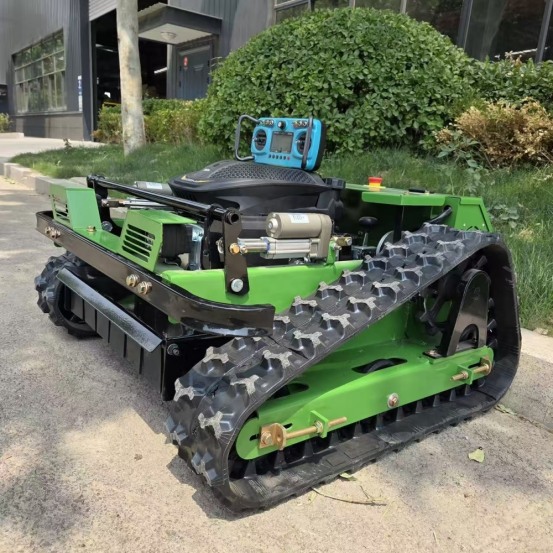
Most machine bodies feature narrow tracks specifically designed to fit between fruit-tree rows. The low-profile design allows weeding right up to tree roots, and the adjustable mowing height cuts only weed stems and leaves without digging deep or damaging fruit-tree roots. It won't collide with tree trunks or fruits — tree protection is far superior to ordinary lawn mowers. The widened anti-skid tracks provide strong grip, moving smoothly on uneven terrain, gentle slopes, and steep inclines without slipping or overturning. Suitable for orchards, mountains, and riverbank slope protection.
Power options: Two types are available — electric and diesel. For large-scale operations, diesel models are preferred: sufficient power, no range restrictions, and capable of crushing coarse vines and old weeds in one pass. For small courtyards and orchards, electric models are ideal — quiet, zero exhaust, and easy to maintain daily.
The machine comes with a grass-crushing function that shreds cut weeds and returns them to the field on site. This not only inhibits weed regeneration but also acts as organic fertilizer — eliminating the need to clean and transport weeds, further saving labor.
Part 3: The Critical Cost Difference
The most critical difference is efficiency and long-term cost. A remote-controlled lawn mower can clean several acres in a single day by one person — with efficiency more than three times that of a regular lawn mower. No need to hire multiple weeding workers all year round. Purchase once, use for many years, and save tens of thousands in labor costs annually. When calculated over the long term, the saved labor costs far exceed the equipment investment — the effect of reducing costs and increasing income is very obvious.
How to Choose
Small courtyard (a few dozen square meters), flat lawns, low weeding frequency: A regular lithium-electric lawn mower is sufficient.
Orchards, slopes, riverbanks, large wasteland areas: Priority should be given to remote-controlled tracked lawn mowers — safe, labor-saving, and they save huge labor costs over the long run.
Many people only look at the upfront purchase price and ignore long-term labor costs, blindly buying ordinary lawn mowers and spending money every year on hired help. By understanding the real differences between regular and remote-controlled lawn mowers — and choosing based on your land size — you can save tens of thousands in labor costs each year while working more easily and safely.
Feel free to contact us anytime — choose your work partner!